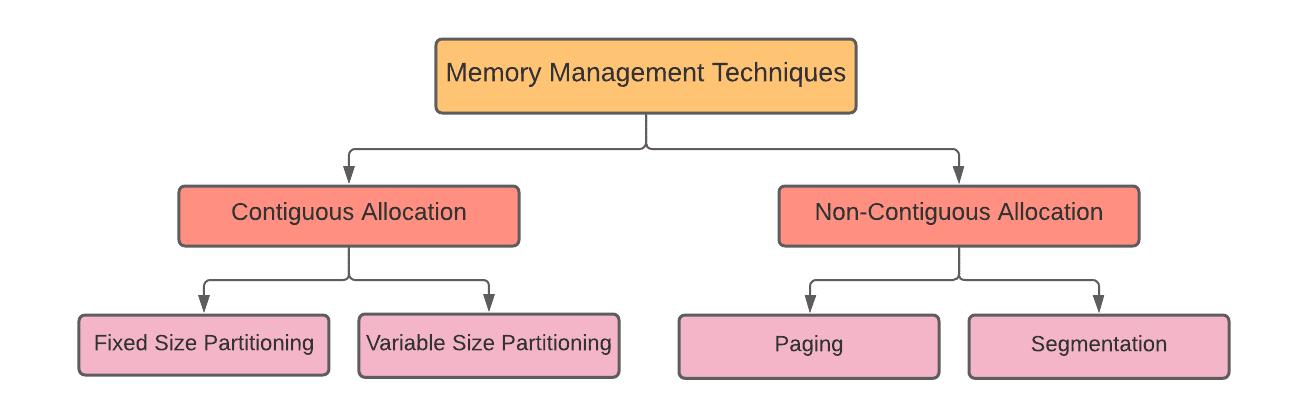
Non-contiguous allocation, also known as dynamic or linked allocation, is a memory allocation technique used in operating systems to allocate memory to processes that do not require a contiguous block of memory. In this technique, each process is allocated a series of non-contiguous blocks of memory that can be located anywhere in the physical memory. Non-contiguous allocation involves the use of pointers to link the non-contiguous memory blocks allocated to a process. These pointers are used by the operating system to keep track of the memory blocks allocated to the process and to locate them during the execution of the process.
There are several advantages to non-contiguous allocation. First, it reduces internal fragmentation since memory blocks can be allocated as needed, regardless of their physical location. Second, it allows processes to be allocated memory in a more flexible and efficient manner since the operating system can allocate memory to a process wherever free memory is available.
However, non-contiguous allocation also has some disadvantages. It can lead to external fragmentation, where the available memory is broken into small, non-contiguous blocks, making it difficult to allocate large blocks of memory to a process. Additionally, the use of pointers to link memory blocks can introduce additional overhead, leading to slower memory allocation and deallocation times.
There are five types of Non-Contiguous Allocation of Memory in the Operating System: